
Grantee Profile
Rooted in Resilience: How the NH Food Alliance is Growing a Stronger, More Equitable Food System
In the heart of New Hampshire, where rolling farms meet bustling school cafeterias, the NH Food Alliance (NHFA) has spent the past year deepening its roots – and its impact.
With more than 360 partners, dozens of events, and the launch of the state’s first-ever strategic food system plan, the NHFA has proven that collaboration isn’t just a value – it’s a strategy for change.
At the core of NHFA’s work is a bold vision: a thriving, fair, and sustainable local food system for everyone in the Granite State. In 2025, that vision took a tangible leap forward with the release of the New Hampshire Food and Agriculture Strategic Plan. This roadmap was the result of a year-and-a-half-long collaboration between NHFA, the NH Department of Agriculture, Markets, and Food, UNH Extension, and over 89 partner organizations. Together, they produced 27 briefs and 140+ actionable recommendations, each aimed at strengthening the viability of New Hampshire farms, fisheries, and food businesses while ensuring equity remains a guiding principle.
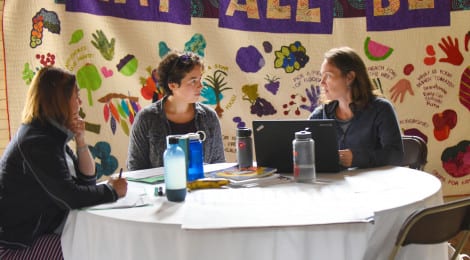
The launch of the Strategic Plan was more than a milestone – it was a moment of unity. In May, over 200 attendees gathered at Sanborn Mills Farm in Loudon for the NH Food System Statewide Gathering. “Today is the largest gathering of people who really care about supporting New Hampshire agriculture that I’ve been to,” remarked Commissioner Shawn Jasper, kicking off the event. Nine breakout sessions transformed recommendations from paper to practice, from new housing strategies for farm workers to statewide branding efforts for NH-grown products.
Beyond planning, NHFA rolled up its sleeves for action. One of the most promising new initiatives was the Local Food for Local Schools Purchasing Incentive Pilot Program, which selected eight schools to receive a 33% reimbursement on local food purchases. It’s more than a financial incentive; it’s an investment in children, farmers, and community well-being.
A companion initiative, the Culturally Connected Cafeterias 2024 New England Food Vision Prize project in Manchester, brought together food service staff, students, and farmers to reshape school menus. At a spring training, Hari Maya Adhikari from Fresh Start Farms demonstrated a traditional Bhutanese noodle broth. Later, Batulo Mahamed of Batulo’s Kitchen in Concord showcased Somali dishes like Ugalli and Kola greens. The goal wasn’t just to celebrate culture – it was to put it on the lunch tray and back it with local sourcing relationships.
Equally focused on infrastructure, NHFA also played a role in distributing USDA Resilient Food Systems Infrastructure (RFSI) funding. This funding strengthens the middle of the food supply chain – distribution, aggregation, and processing – by helping food businesses invest in shared-use equipment. Field trips and workshops by the NH Food Alliance planned for 2025 aim to inspire even more value-chain collaboration across the state.
Meanwhile, NHFA’s communications work helped New Hampshire eat local – loudly and proudly. During NH Eats Local Month, over 350 food businesses participated in the “Live Free & Eat Local Challenge,” with new partners including breweries and public libraries joining the celebration. The Alliance distributed 28,000+ promotional materials and grew its monthly newsletter audience to nearly 2,900 subscribers.
One of the most unifying aspects of NHFA’s work is its Network Café Series, which offered monthly opportunities for discussion and learning on key topics – from seafood supply chains to farmland protection. A remarkable 100% of survey respondents found the cafés valuable to their work. “This is not a matter of one organization or one person doing all of it,” said Rep. Peter Bixby at a café. “We’re hoping many, many people will be working on the Strategic Plan recommendations in the ways that they are able.”
As part of its own evolution, NHFA transitioned in July 2025 from the UNH Sustainability Institute to the College of Life Sciences and Agriculture. This shift brings Farm to School programming fully under the NHFA umbrella, aligning school-based initiatives more closely with broader food system goals.
Throughout all of this, NHFA remained deeply connected to regional partners – from participating in the New England Food System Planners Partnership to co-leading the New England Food Hub and Processors Network. Whether it’s creating a wholesale producer directory, convening technical assistance providers, or supporting young fishermen, NHFA’s work echoes across New England.
With every training session, policy forum, and school food pilot, the Alliance cultivates more than food – it cultivates connection. “This event helps me see the bigger picture,” shared a participant at the 2025 Statewide Gathering. “It re-energizes my commitment and reminds me that I’m part of something larger.”
In a time of climate uncertainty, rising food insecurity, and supply chain challenges, NHFA’s 2024–2025 accomplishments demonstrate what’s possible when people work across sectors, silos, and systems. Together, they are growing a food future rooted in resilience – and ready to flourish.


Photos courtesy Katie Hall Photography
Group photo caption: Several members of the NH Food and Agriculture Strategic Plan Advisory Committee celebrating the launch at the NH Food System Statewide Gathering. Pictured left to right: Anton Bekkerman, NH Agriculture Experiment State; Amy Loader, UNH Cooperative Extension; Xochi Salazar, NOFA-NH; Cameron Huftalen, Vital Communities; Todd Horner, Southeast Regional Planning Commission; Commissioner Shawn Jasper, NH Department of Agriculture, Markets, and Food; Jo Porter, NH Center for Justice and Equity; Nicole Cardwell, NH Food Alliance
Related Content
Grantee Profile
Advancing Farm to School through the Massachusetts Farm to School Institute
Grantee Profile
Creating Community & Opportunity Through Food Entrepreneurship